
In New Braunfels, you generally do not need a permit to place a rented dumpster on your own driveway or yard. You do need a permit if the dumpster will sit in the street, on a sidewalk, or anywhere else within the public right of way. Permanent dumpsters for businesses are a separate matter entirely: they require a Building Department permit and must meet detailed pad, screening, and truck access standards under Section 110-58 of the city’s Code of Ordinances before the city will collect from them. The rest of this guide walks through each of those situations in detail, plus the parts of the rulebook that almost nobody talks about.
Quick Answer
Private property placement (driveway, yard, or a paved area you own) typically requires no city permit. Public right of way placement (street, alley, or sidewalk) requires a right of way permit from the city. Permanent commercial dumpster pads and enclosures require a Building Department permit and must follow the screening and access standards in Section 110-58. Dumpster rental itself is handled entirely by private haulers, and only haulers holding a current City of New Braunfels Commercial Solid Waste Hauler Permit are allowed to operate inside city limits. HOA rules are separate from city rules and are not enforced by the city.
Related reading: Do You Need a Permit to Place a Dumpster in New Braunfels? and What Size Dumpster Do I Need? New Braunfels Sizing Guide
Do You Need a Permit to Place a Dumpster in New Braunfels?
The answer depends entirely on where the dumpster sits, not on its size or how long you’re keeping it.
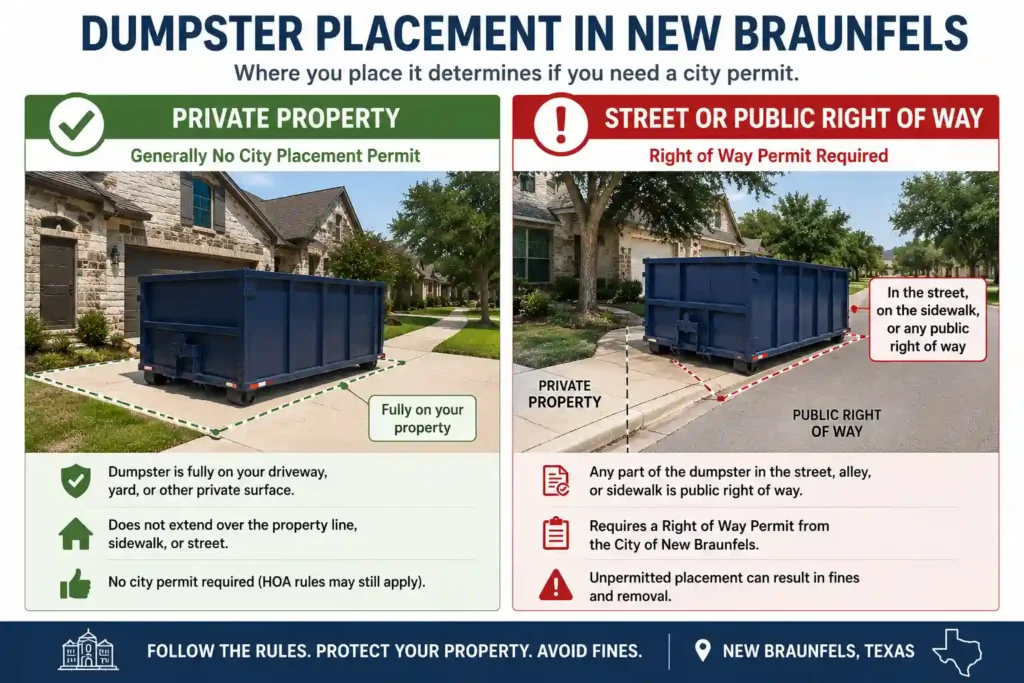
Placement on Private Property
If the dumpster stays fully on your own property, in the driveway, on a concrete pad, or elsewhere in your yard, the city does not require a placement permit. This applies to both residential roll-off rentals for a home renovation and to smaller front-load containers used temporarily during a remodel. The practical requirements come from common sense and from your rental company’s terms rather than from an ordinance: the surface should be solid enough to bear the weight of a loaded container, and the spot needs enough clearance for the delivery truck to maneuver without damaging structures, trees, or utility lines.
Two things trip people up here. First, “private property” means the dumpster cannot extend over the property line, even partially. A container that hangs a few feet into the street or over the sidewalk while parked in a driveway is no longer fully on private property and can put you back into right of way territory. Second, an HOA can still object even when the city has no issue with the placement, which is covered in its own section below.
Placement in the Street or Public Right of Way
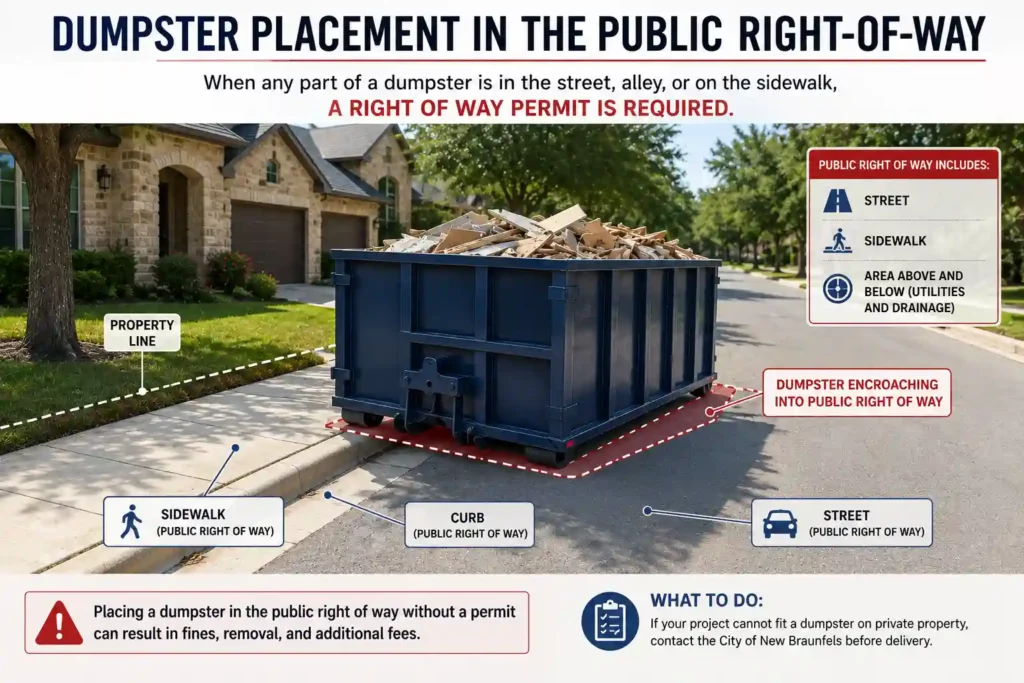
Once any part of a dumpster sits in the street, an alley, or on a sidewalk, it is occupying public right of way, and the city’s right of way permitting process applies. City documentation and the ordinance establishing right of way procedures define right of way broadly: it covers the street itself, the sidewalk, and the space above and below them where the city holds a property interest, including areas used for utility lines and drainage.
This matters for a specific reason many rental companies gloss over: a right of way encroachment isn’t just a placement inconvenience, it is a licensed use of city property. Section 114-7 of the Code of Ordinances treats encroachments on public right of way as something that requires a license agreement, and unpaid fees tied to that agreement can attach as a lien against the adjoining property. In practice, most short-term dumpster placements are handled through a right of way permit rather than a full license agreement, but the underlying principle is the same: you are borrowing city property, and the city expects that use to be documented and approved, not assumed.
If your project genuinely cannot fit a dumpster on private property, the right move is to contact the city before delivery day, not after a container is already sitting at the curb.
Who Is Actually Allowed to Deliver a Dumpster in New Braunfels
This is a piece of the rulebook that almost every competing article skips entirely, and it changes how you should think about hiring a hauler.
New Braunfels does not operate its own dumpster rental service. Every roll-off and commercial container in the city is delivered by a private hauling company, and the city maintains a public list of the haulers currently authorized to operate within city limits. To get on that list, a company must hold a Commercial Solid Waste Hauler Permit under Chapter 110 of the Code of Ordinances. That permit is issued per vehicle, requires proof of insurance, a completed application, a vehicle list, and a customer list, and the city reserves the right to inspect a hauler’s vehicles for suitability. Permits run for twelve months and are paid either as a single annual fee or in quarterly installments due January 1, April 1, July 1, and September 1, with no proration if a company starts partway through the year.
Why does this matter to you as the person renting a dumpster? Two reasons. First, if a hauler is operating without a current permit, using them can create headaches that have nothing to do with where you place the container, since the city can act against unpermitted haulers. Second, permitted haulers already know the local placement and screening rules, which is one real advantage of sticking to a company on the city’s current list rather than an out-of-area broker with no physical presence in Comal County.
Residential Roll-Off Placement: What to Actually Plan For
For a homeowner renting a 10 to 40 yard roll-off for a cleanout, home renovation project, or roofing job, private property placement is almost always the simpler and faster path. Here is what experienced local haulers plan around, even though it isn’t written into a city ordinance line by line.
Surface and Footing
A loaded roll-off, especially a 30 or 40 yard container full of construction debris, can weigh several tons, and a concrete or dirt disposal load gets heavy fast even in a smaller container. Concrete or asphalt driveways handle this fine. Gravel, grass, or soft soil can rut or crack under that weight, particularly after Hill Country rain. Many haulers will lay down plywood or protective boards under the wheels and skid rails on request, and it’s worth asking for this rather than assuming your driveway can take the load without it.
Truck Access and Overhead Clearance
Roll-off trucks need a straight, clear approach, generally somewhere in the range of 60 feet of length and roughly 20 to 25 feet of vertical clearance to raise the container without snagging tree limbs, power lines, or eaves. This is one area where New Braunfels’ older neighborhoods and heavily wooded lots around Gruene and the river corridor genuinely differ from a newer subdivision with a wide, open driveway. If you’re not sure your site clears, it costs nothing to walk the delivery path yourself with these numbers in mind before the truck shows up.
How Long a Dumpster Can Stay
The city does not set a blanket time limit for a dumpster sitting on private property, since that’s a matter between you and your rental company. Rental agreements typically run 7 to 30 days with extension options. Right of way placements are a different story: because that placement is tied to a permit or license, the city can and does set the term, and leaving a container in the street indefinitely without renewing that authorization is a violation, not a gray area.
HOA Rules Are Not City Rules, and the City Will Tell You That Directly
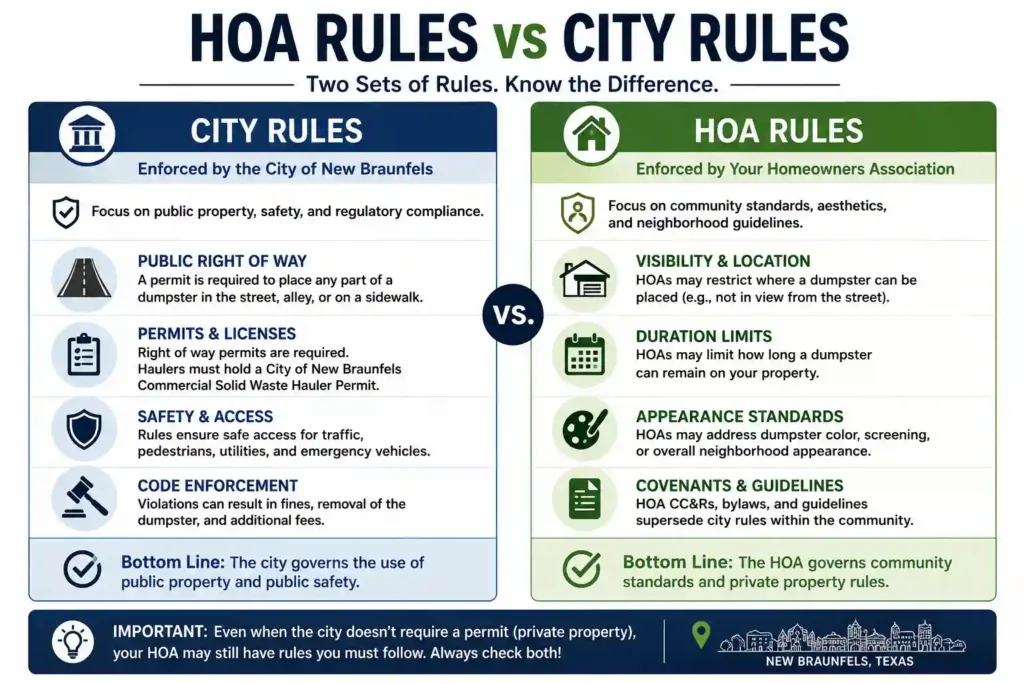
This is one of the most useful, and most consistently overlooked, pieces of information for anyone placing a dumpster in a New Braunfels subdivision. The city’s own Code Compliance Division has stated plainly that it does not enforce deed restrictions or homeowners association covenants. Those are civil matters between you and your HOA unless the restriction happens to overlap with an actual city ordinance.
In practice, that means a dumpster can be perfectly legal under city code, sitting entirely on your own driveway with no right of way issue whatsoever, and still violate your HOA’s rules on visible containers, minimum setbacks from the street, or how long equipment can sit in a driveway. Communities across Comal County, including many newer developments around New Braunfels, have their own covenants on this exact topic. If you live in an HOA, check your covenants or ask your HOA management company before delivery, because a call to the city will not resolve an HOA dispute, and the city has no authority to override or enforce your association’s rules either way. If you’re not sure how a specific New Braunfels community tends to handle this, give our team a call before delivery, since we place containers across these neighborhoods regularly and can flag common sticking points.
Dumpster Placement Outside New Braunfels City Limits
New Braunfels sits inside Comal County, and a meaningful number of addresses that people think of as “New Braunfels” are actually in the county’s unincorporated area or the city’s extraterritorial jurisdiction, not inside the actual city limits. This distinction matters more than most homeowners realize.
The City of New Braunfels does not enforce its ordinances outside its own city limits. If your property uses a New Braunfels mailing address but sits in unincorporated Comal County, the city’s dumpster, right of way, and screening rules described in this guide simply do not apply to you. Instead, placement is governed by Comal County regulations, and for anything touching a county or state road, by the relevant county or Texas Department of Transportation right of way rules rather than the city’s. If you’re near a boundary and unsure which jurisdiction you’re in, the safest step is a quick call to confirm, since the wrong assumption here can mean contacting the wrong office entirely when a question comes up.
Permanent Commercial Dumpster Enclosures: The Detailed Rules
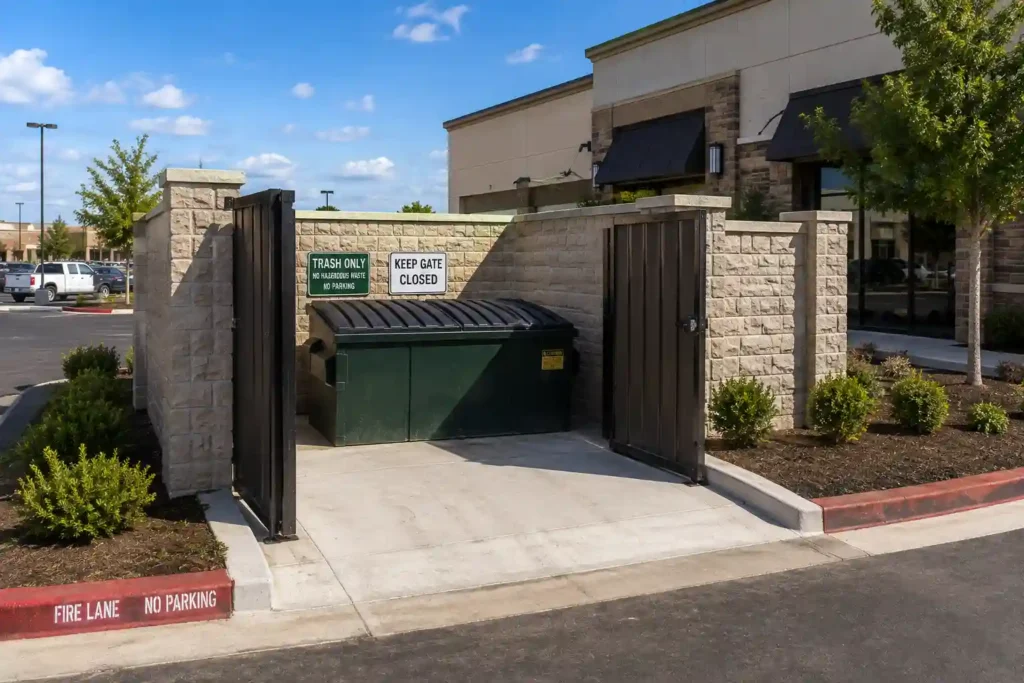
Everything covered so far applies to temporary, rented containers. Businesses that need an ongoing commercial dumpster, the kind sitting behind a restaurant, retail center, or apartment complex and collected on a regular schedule, are governed by an entirely different and far more technical set of standards under Section 110-58 of the Code of Ordinances. If you’re a business owner, property manager, or contractor setting up a new commercial account, this is the part of the code that actually determines whether the city will collect from your container at all.
A Building Permit Comes Before the Dumpster
No permanent dumpster or screening structure can be installed without first obtaining a permit from the Building Department. The application has to include a scaled plat of the property showing the dumpster’s exact location, all existing structures, utilities, storm drain inlets, and public rights of way, along with the required screening. The property owner or the person with control of the site has to sign a statement certifying the plat is accurate. This isn’t a rubber-stamp process, and skipping it is why some new businesses find their dumpster service delayed at the exact moment they need it most.
Pad and Screening Specifications
The physical standards are specific enough that a contractor can build to them directly:
- The concrete pad and apron must be six inches thick, reinforced with number four rebar on 18 inch centers, centered within the slab.
- Every container must be screened from the right of way and from adjacent properties by a screen at least seven feet high, built of stone, masonry block, or wood or chain link fencing with slats.
- A gate is required wherever the enclosure opening is visible from the public right of way. The gate must open to a minimum width of 12 feet, swing a full 180 degrees, and use a positive locking mechanism while open.
- Enclosures cannot sit closer than 30 feet to any storm drain or within a drainage flow area.
- The city prefers screening structures to sit outside any public easement. If a utility repair requires removing a screen, the property owner pays to replace it, not the city.
Interior Enclosure Dimensions
The minimum interior clearance depends on how many containers the enclosure holds:
- A single 3, 4, 6, or 8 yard dumpster enclosure needs at least 10 feet of depth by 12 feet of width, with gates matching the full opening width.
- A double enclosure for two containers needs at least 10 feet deep by 24 feet wide.
- A triple enclosure needs at least 10 feet deep by 36 feet wide.
- A roll-off compactor enclosure needs a minimum of 29 feet deep by 16 feet wide.
Truck Access and Maneuvering Room
This is the section that trips up site plans drawn without a waste hauler’s input. Access areas leading to the enclosure must be at least 20 feet wide, 65 feet long, and 16 feet high, with outside turning radii of at least 45 feet. Collection vehicles cannot be required to back up more than 50 feet on the property, cannot be required to back while turning, and cannot be required to back directly into or out of the public right of way. If a site can’t meet that, the code requires a tee or circle turnaround instead. In front of the enclosure itself, there needs to be a clear maneuvering area of up to 65 feet, with no parking allowed in that zone, and the maximum deviation from the truck’s access path to the enclosure is 30 degrees.
For a business owner reviewing site plans, this single set of rules is often the difference between a collection truck that can service the property smoothly every week and one that requires the driver to perform awkward, repeated backing maneuvers, which haulers will flag and sometimes refuse.
When the City Grants Exceptions
The code builds in some real flexibility. If the Solid Waste Manager determines that a site genuinely cannot meet these standards, or that meeting them would be wholly impractical, that office has the discretion to designate an alternative, more accessible location for the dumpster, or to grant an exemption from the requirements. This is worth knowing if you’re working with a tight or oddly shaped commercial lot, since it means the standards above are a strong default, not always an absolute wall.
What Happens If You Don’t Follow the Rules
For commercial haulers, noncompliance with Chapter 110’s rules can result in fines and penalties, and repeated violations put a hauler’s permit at risk, which affects every customer that hauler services. For an individual placing a dumpster without authorization in the right of way, the practical consequences typically include a request from the city to move or remove the container, potential fines, and in persistent cases the city can pursue further code enforcement action. The bigger everyday risk isn’t usually a fine at all, it’s a dumpster blocking a travel lane or sidewalk in a way that becomes a liability if a vehicle, cyclist, or pedestrian is involved. Placement rules exist for sightlines and safety first, and code compliance second.
Free and Low-Cost Alternatives Worth Considering First
Not every cleanout needs a rented dumpster, and the city offers a few services that can reduce or eliminate the need for one entirely.
Bulky Goods Drop-Off runs once a quarter at four sites around the city, letting residents drop off up to five oversized items and four passenger tires per household, per event, at no cost. It’s a strong option for furniture, mattresses, or appliance disposal without renting a full container, though a full estate cleanout or a season of storm-related yard waste usually still calls for a rented dumpster. The city also runs a Household Hazardous Waste drop-off for items like chemicals, oil, and cleaners that shouldn’t go in a dumpster at all, and a City Recycle Center for loose recyclables. For an ongoing overflow of regular household trash, requesting a second curbside cart is usually far cheaper than a dumpster rental for what amounts to routine waste rather than a one-time project.
Placement Checklist Before You Order a Dumpster
- Confirm whether the delivery spot is entirely on private property or touches any part of the street, alley, or sidewalk.
- If it’s private property only, measure for a straight approach with roughly 60 feet of length and adequate overhead clearance.
- If any part of the placement touches the right of way, contact the city about a right of way permit before scheduling delivery.
- Confirm your hauler currently holds a City of New Braunfels Commercial Solid Waste Hauler Permit.
- Check your HOA covenants separately from city rules, since the city will not resolve an HOA dispute.
- If your address is near the city limit line, confirm whether you’re actually inside city limits or in unincorporated Comal County before assuming city rules apply.
- For a permanent business dumpster, start with the Building Department permit and a site plan before ordering any construction, since the pad and screening standards affect the whole layout.
Ready to schedule delivery? Call or request a quote and we’ll help confirm a placement plan that fits your property before the truck arrives.
Frequently Asked Questions
Do I need a permit to put a dumpster in my driveway in New Braunfels? No. Placement fully on private property, such as a driveway or yard, generally does not require a city permit.
Can I place a dumpster on the street in New Braunfels? Only with a right of way permit from the city. Any part of a dumpster sitting in the street, alley, or on a sidewalk is considered right of way encroachment and requires authorization.
Does the City of New Braunfels enforce HOA rules about dumpsters? No. The city’s Code Compliance Division does not enforce HOA covenants or deed restrictions. Those are handled between you and your homeowners association.
Who regulates dumpster rental companies in New Braunfels? The city’s Solid Waste and Recycling Division, under Chapter 110 of the Code of Ordinances. Haulers must hold a current Commercial Solid Waste Hauler Permit to legally operate inside city limits, and the city publishes a list of currently permitted haulers.
What if my address is near New Braunfels but technically outside city limits? City ordinances only apply inside the actual city limits. If you’re in unincorporated Comal County or the city’s extraterritorial jurisdiction, county rules apply instead, and it’s worth confirming your exact jurisdiction before assuming which office to contact.
Do permanent business dumpsters need to be screened from view? Yes. Section 110-58 requires a minimum seven foot screen around commercial enclosures, visible from the right of way or adjacent properties, along with a gate meeting specific width and swing requirements.
What happens if a dumpster blocks the street without a permit? The city can require it to be moved or removed, and unauthorized placement can result in fines. Beyond the code issue, an unpermitted container in a travel lane or on a sidewalk is a real safety hazard for drivers and pedestrians.
This guide reflects the City of New Braunfels Code of Ordinances and official city resources as of 2026. Ordinances and permit procedures can change, and enforcement details can vary by situation, so confirm current requirements with the City of New Braunfels Solid Waste and Recycling Division or the Building Department before finalizing plans for a permanent enclosure or a right of way placement.